
Record Heat Sizzled Away the Snow. Here’s How California is Preparing for What’s Ahead
Light snow is seen on the meadow where the California Department of Water Resources prepares to conduct the fourth media snow survey of the 2026 season at Phillips Station in the Sierra Nevada. Photo taken April 1, 2026.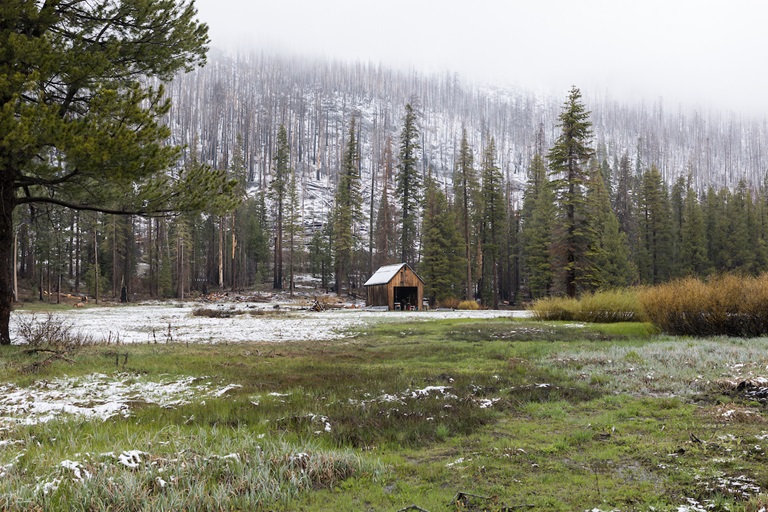
The Department of Water Resources found no measurable snow April 1 at a place in the Sierra Nevada mountains where more than two feet of snow stood in late February. A record-breaking hot and dry March sizzled away the snow, leaving a field of mud and grass.
“Are we heading into hydrologic drought?” said DWR Director Karla Nemeth at the snow survey. “The answer is, I don’t know. We could be . . . we’ll know with more clarity next year if this year in fact is the start of a hydrologic drought in California and throughout the West.”
Whatever future conditions hold, California is better prepared than ever for drought. Major, recent investments and policy changes have strengthened the capacity of small and large water systems to cope with prolonged lack of precipitation.
Large urban water districts that serve most Californians already have demonstrated an ability to handle drought without major disruption, thanks to decades of investments to diversify supply sources and build new storage.
But should California experience another series of consecutive dry years, history has shown that it could leave some rural communities without water, interrupt surface water deliveries to farms, disrupt farm jobs, imperil fish and wildlife, and create conditions that fuel catastrophic wildfire.
Recent droughts spurred a great deal of progress toward containing many of those effects of drought.
California experienced five consecutive dry years from 2012 to 2016, then its driest consecutive three-year period on record from 2020 through 2022. Each of those droughts triggered state and local responses that positioned many small water systems and private well owners to cope better with an extended lack of precipitation.
For example:
- In 2020 and 2021, DWR helped distribute more than $1 billion in drought relief funding for communities for projects such as replacing water tanks, rehabilitating wells, and connecting to more reliable water supplies.
- Separately, the State Water Resources Control Board, through its Safe and Affordable Funding for Equity and Resilience (SAFER) program, has provided over $1.8 billion in grants since 2019 for projects to bring safe drinking water to small, disadvantaged communities. During this same period, over 170 water system consolidations have been completed, connecting over 360,000 people to safe drinking water in their homes.
- Overall, the number of Californians who lack access to safe and affordable water has fallen from an estimated 1.6 million in 2019 to fewer than 600,000 today. This progress means that many more people have greater resilience to drought impacts today than a few years ago.
- In 2021, the Legislature and Governor enacted a law aimed at improving drought planning. The law requires suppliers with fewer than 3,000 connections to have a water shortage contingency plan, annually report their water supply conditions and use by month, and upgrade their infrastructure to drought-resilient standards, if necessary. Each county is to develop a plan proposing interim and long-term solutions for water shortage risk for systems with five to 14 service connections and household wells. Finally, the law required DWR to create and update a Water Shortage Vulnerability Tool and to establish a standing interagency task force to advise state agencies on drought preparation and response. That task force, the DRIP Collaborative, is discussing roles and responsibilities related to household wells and small water systems and drought indicators and metrics.
As operator of the State Water Project, DWR has acted to improve water supply for most Californians if next year is dry.
Starting in 2019, DWR increased the amount of water that it holds back in Lake Oroville each summer, as a hedge against the possibility that the following year is dry. By increasing this so-called “carryover storage,” DWR improves the ability of the State Water Project to deliver water supplies the following year.
Longer-term, DWR is working to build the Delta Conveyance Project, which would improve the ability of the State Water Project to move water into storage during times of high flow. Dozens of local water districts around the state are investing in the proposed Sites reservoir as a way to bolster their drought-year supplies.
Perhaps most crucially, hundreds of local agencies around the state are working to comply with a historic law, the Sustainable Groundwater Management Act (SGMA), enacted in the critically dry year of 2014. SGMA requires water districts that have relied too heavily for too long on groundwater to bring basins into sustainable conditions, which will restore groundwater as a trustworthy water savings account that can sustain California farms and communities through drought.
To learn more about current groundwater conditions and SGMA implementation, see California’s Groundwater, newly published by DWR.