Dutch Slough Tidal Restoration Project
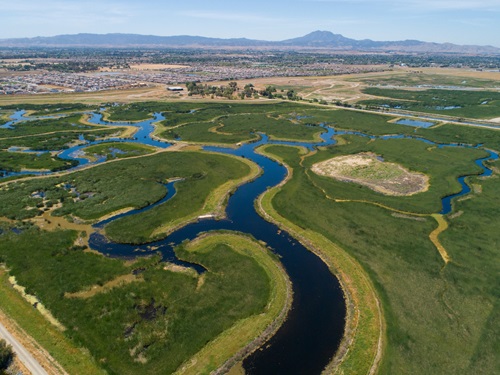
The Dutch Slough Tidal Marsh Restoration Project site, located in the Sacramento-San Joaquin Delta near Oakley, California. DWR/2021
As of fall 2021, the Dutch Slough Tidal Marsh Restoration Project has restored approximately 700 acres of natural Delta habitats to a 1,187-acre site in the western Delta city of Oakley. The site, which was formerly slated for urban development, will continue to become critically needed habitat for native fish and wildlife species. The project’s location in the western Delta offers the opportunity, soil types, freshwater, and lack of subsidence to create a large area of tidal marsh and complex intertidal channels favored by native Delta species. Tidal habitats are those that were historically prominent in the Delta, and their restoration is considered a critical action to increase the number of native sensitive species and improve the general ecological health of the Delta. Riparian forests and grasslands are being restored on the higher elevation lands of the site.
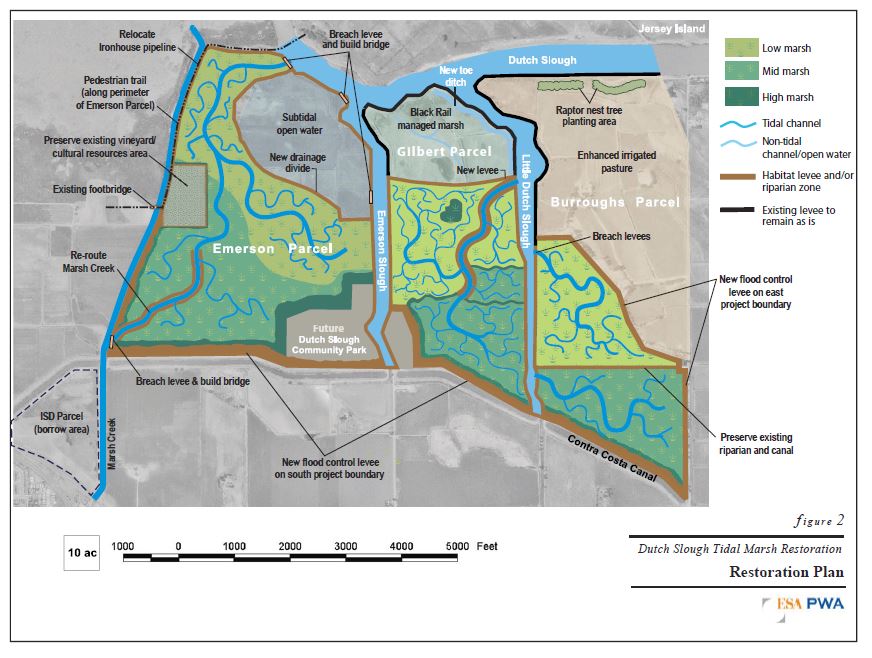
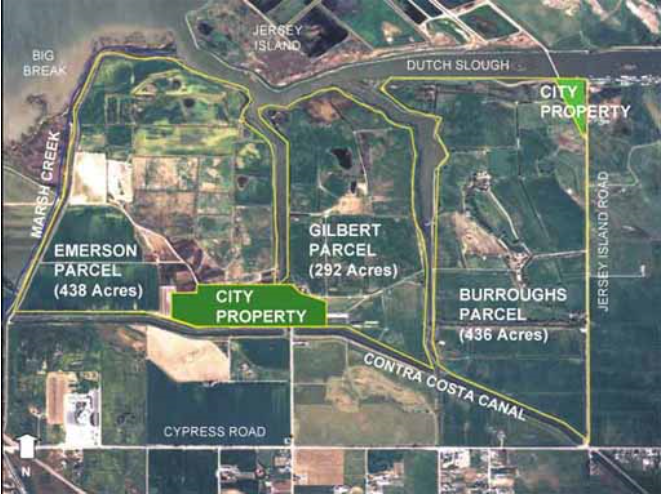
The project site consists of three leveed parcels, two of which have been restored. The remaining parcel will also be restored to a mosaic of tidal marsh, riparian woodland, open water, non-tidal freshwater marsh, and grassland habitats. Construction consists of earthmoving to create the proper elevations for gradually sloping marsh plain, and other project features such as channel berms, the rehabilitation of existing levees, construction of new flood control levees, and site revegetation. The project is being implemented by the California Department of Water Resources (DWR) Delta Levees Program as part of its legislative mandate to provide ‘net habitat improvement’ in the Delta. In addition to habitat restoration, the project will provide recreation and educational opportunities to benefit residents of the Delta, and adaptive management components to inform future Delta restorations.
The project was part of the California EcoRestore initiative to advance 30,000 acres of critical habitat restoration in the Delta by 2020 and will also support the Healthy Rivers and Landscapes Program by providing tidal marsh habitat in the Delta.
The project has three main goals:
- Benefit native species by re-establishing a natural ecological network, especially for Delta species currently in decline
- Contribute to scientific understanding of ecological restoration in the Delta
- Provide shoreline access, education, and recreational opportunities
Status update:
Construction to grade two of the parcels, Emerson and Gilbert, started in May 2018 and was completed late in 2019, followed by revegetation starting in late 2019/early 2020. After 1.5 years of planting and establishment, the levees were breached in five locations with the final breach taking place in November of 2021. Two bridges were installed to provide access to the Marsh Creek Regional Trail system that goes along the project's western edge and to facilitate a future expansion of a loop trail around the westernmost parcel.
Restoration of the third parcel, Burroughs, is currently estimated to begin construction in summer 2026 to create an additional 200 acres of tidal marsh and increase flood protection to the neighboring communities. This project phase will also enhance another 220 acres of pasture and upland habitats on the northern end of the parcel.
Public access is a partnership effort between the City of Oakley, East Bay Regional Park District, and DWR. The three entities are working to secure funding and put agreements in place to develop and maintain a trail system. Trail opening date is yet to be determined.
How it works:
Before construction Dutch Slough had site elevations ranging from six feet above sea level to six feet below sea level. Construction consisted of excavating soil from higher elevations and moving it to lower elevations and carving channels. Then River Partners planted about 15,000 tule 1x1' to 2x2' "plugs" across the low and mid-marsh plains. They also planted 160,000 perennials, shrubs and trees in the upland areas. The project reestablished what was once a tidal marsh and created a diverse mosaic of habitats for fish and wildlife.
Protecting fish:
The Dutch Slough project is one of the Delta’s largest restored fresh water tidal marshes. The tidal marsh was designed to create with many long, sinuous channels to favor native aquatic species over non-native fishes such as largemouth bass. The aim is to provide young salmon places to hide from predators in the marsh at high tide. Scientists are showing that the tidal marsh is providing food and rearing habitat for the young salmon to grow strong before they journey toward the ocean, boosting their survival rates.
Preserving land:
The Dutch Slough project preserves Native American heritage sites and protects one of the last remaining dryland vineyards that is over 100 years old growing on relict Antioch dune sand sheet. The vineyard preservation has the added benefit of supporting rare dune plant and insects on its edges.
Creating recreation and education:
Fifty-five acres of the south-central portion of Dutch Slough is being developed by the City of Oakley into a community park. The restoration project's public access trail will enhance park amenities by including biking and walking trails, plus shoreline access.
Living Laboratory:
The project was designed to support scientific research to inform future wetland restoration efforts and adaptive management practices. Through its function as a living laboratory, various researchers are studying everything from soil accretion, what birds are occupying the site over time, to cutting edge climate science. Due to the revegetation efforts prior to breaching, the project has been performing as an old marsh and sequestering carbon in the top one percent globally.
History:
The Dutch Slough project began in 2003, when DWR bought the property for $28 million. Before that, Contra Costa County planned to convert pastureland into a development of 5,000 houses. The project was 20 years in the making, following a long approval process by a variety of federal, state and local agencies.
Project Partners:
The Dutch Slough Tidal Marsh Restoration Project is part of the DWR Delta Levee System Integrity & Delta Habitat Restoration Program, which funds levee improvements and projects that preserve and restore habitats in the Delta. It is also a part of multi-agency endeavors to enhance ecological function across the greater Delta.
Dutch Slough has been supported by:
- California Natural Resources Agency
- The U.S. Environmental Protection Agency
- U.S. Fish and Wildlife Service
- State Coastal Conservancy
- California Department of Fish and Wildlife (CDFW)
- The City of Oakley
- Contra Costa Water District
- The Delta Conservancy
- Natural Heritage Institute
- American Rivers
- River Partners
- Reclamation District 2137
Research Partners include:
- USGS Western Ecological Research Center
- UC Davis' - Center for Watershed Sciences, Museum of Wildlife and Fish Biology and Bohart Museum
- UC Berkeley's - Biometeorology Lab
- Cramer Fish Sciences
- River Partners
- Hydrofocus, Inc.
Adaptive Management and Monitoring
Dutch Slough Adaptive Management and Monitoring Plan Version 2, June 2016
Supplemental Environmental Impact Report (EIR)
Final Supplemental EIR: Dutch Slough Tidal Marsh Restoration Project, September 2014
Written Comments and Lead Agency Responses to Comments on the Draft Supplemental EIR, March 2014
Draft Supplemental EIR: Dutch Slough Tidal Marsh Restoration Project, January 2014
Environmental Impact Report (EIR)
Final EIR: Dutch Slough Tidal Marsh Restoration Project: Comments and Responses, March 2010
Resources
Maps
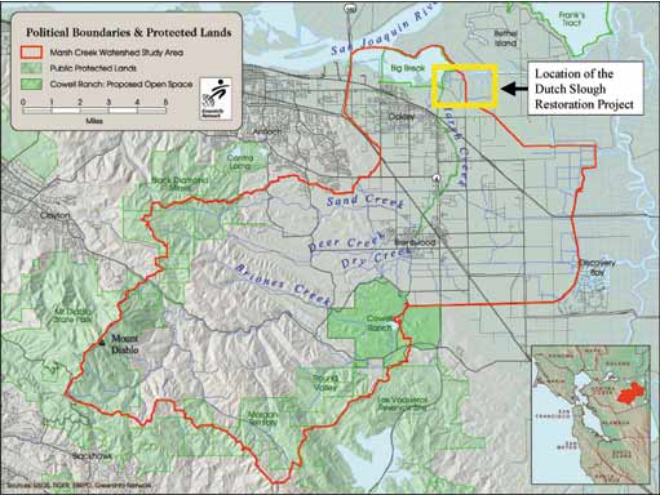
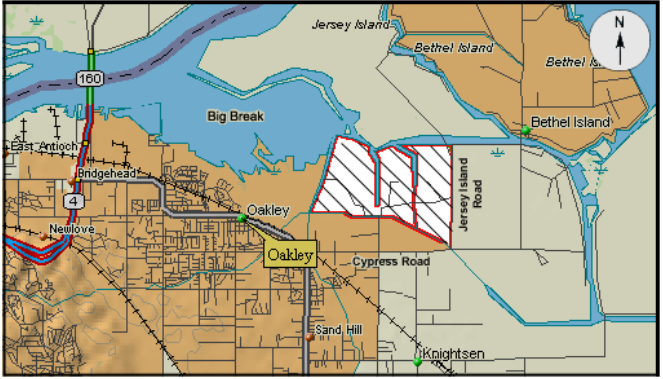
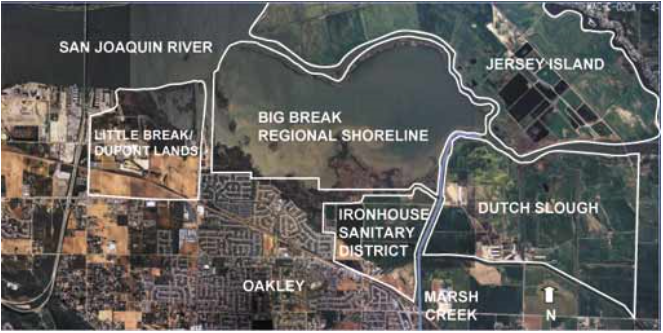
The Dutch Slough site is located in the City of Oakley, eastern Contra Costa County, in the western Delta. The site encompasses 1,178-acres, and is bound by Dutch Slough on the north, Marsh Creek on the west, the Contra Costa Canal on the south, and Jersey Island Road on the east. The site comprises three parcels, partially separated by Emerson Slough and Little Dutch Slough. View the Dutch Slough Tidal Marsh Restoration Plan.