
DWR today conducted the second snow survey of the season at Phillips Station. 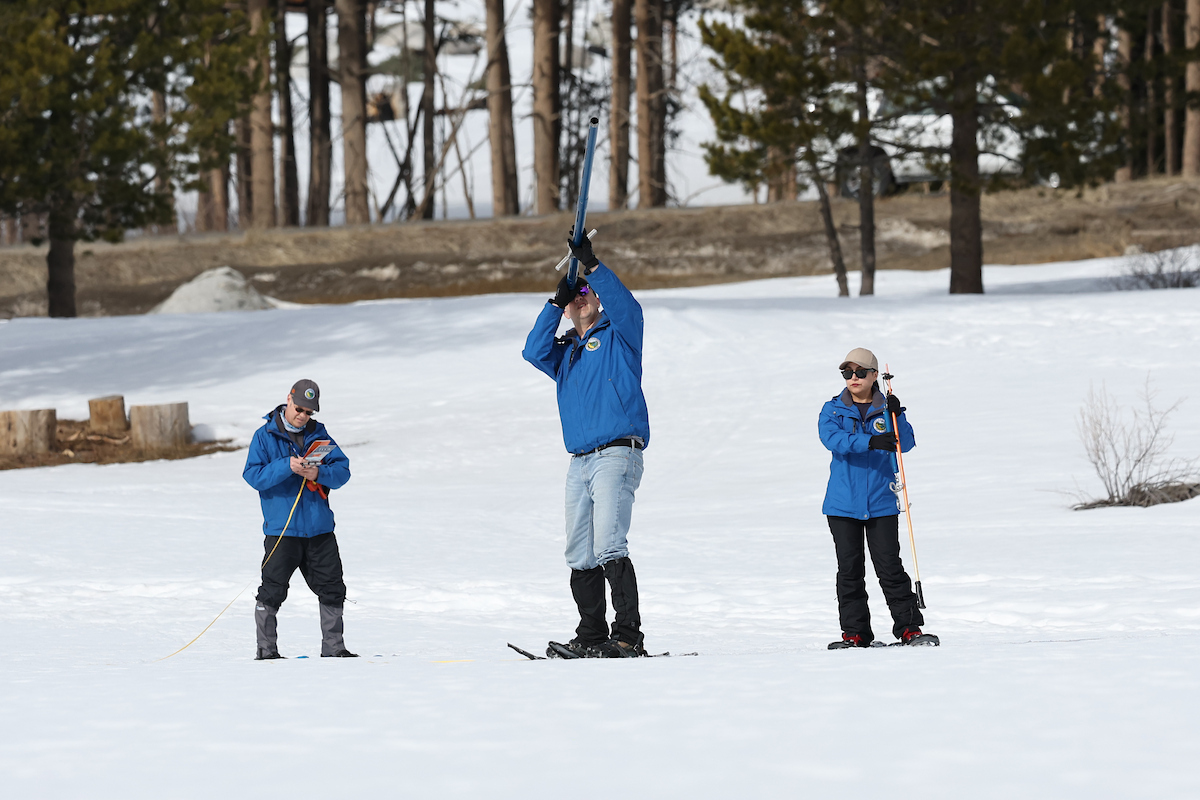
As Dry Conditions Reduce Snowpack Levels, Seasonal Outlook Remains Uncertain
SACRAMENTO, Calif. – The Department of Water Resources (DWR) today conducted the second snow survey of the season at Phillips Station. The manual survey recorded 23 inches of snow depth and a snow water equivalent of 8 inches, which is 46 percent of average for this location. The snow water equivalent measures the amount of water contained in the snowpack and is a key component of DWR’s water supply forecast. Statewide, the snowpack is 59 percent of average for this date.
Three weeks ago, the snowpack was 89 percent of average after a series of atmospheric rivers provided relief from a slow start to the snowpack. A dry January, which is historically the wettest month of the year in California, has now eroded the gains made at the start of the year and forecasts currently show no major precipitation in the next two weeks.
“After the storms at the start of the year gave way to warm, dry conditions, those early gains we saw have flatlined or slightly eroded,” said Andy Reising, Manager of DWR’s Snow Survey’s and Water Supply Forecasting Unit. “Recent California winters have seen this pattern of long, dry and warm stretches interrupted by intense storms. We are now two-thirds through what should be the best snow-producing months of the year. While there is still time for February and March to deliver additional snow, the farther into the season we get with below average conditions, the harder it will be to catch up.”
DWR’s electronic readings from 130 stations placed throughout the Sierra Nevada indicate that the statewide snowpack’s snow water equivalent is 9.7 inches, or 59 percent of average for this date, compared to 67 percent on this date last year. On average, the largest snow-producing months in the Sierra Nevada are January, February, and March.
While the state has experienced a recent dry spell, major reservoirs statewide are currently 126 percent of average thanks to recent precipitation on top of three consecutive years of above-average snowpack conditions, as well efforts by California to capture and store as much water as possible.
On average, the Sierra snowpack supplies about 30 percent of California’s water needs. Its natural ability to store water is why the Sierra snowpack is often referred to as California's “frozen reservoir.” Data from these snow surveys and forecasts produced by DWR’s Snow Surveys and Water Supply Forecasting Unit are key factors in determining how DWR manages the state’s water resources. Snowpack runoff forecasts drive many water management decisions including State Water Project allocations.
DWR conducts four media-oriented snow surveys at Phillips Station each winter near the first of each month, January through April and, if necessary, May. The next survey is tentatively scheduled for March 2.
For California’s current hydrological conditions, visit https://cww.water.ca.gov.
Additional Resources
- Video of today’s Phillips survey
- Digital photos of today’s Phillips survey
- B-roll of today’s Phillips survey
- Snowpack readings (View readings for current regional snowpack and historical snowpack comparison)
- Precipitation data (View current California Data Exchange Center charts for the Northern Sierra 8-station index for updated rainfall readings in the critical northern portion of the state, as well as the San Joaquin 5-station index and Tulare Basin 6-station index)
Contact:
Jason Ince, Public Affairs, Department of Water Resources
(916) 820-8138 | media@water.ca.gov