
Watershed Resilience Program
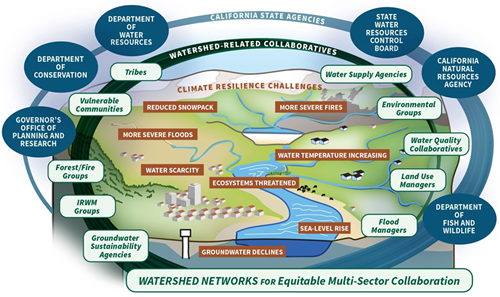
Graphic showing the many partners involved in watershed networks for equitable multi-sector collaboration and the climate resilience challenges they face.
Announcements
Proposition 4 information will be provided as it becomes available. Check this website frequently for updates.
The Draft Guidelines and Proposal Solicitation Package were released September 10, 2026. Please scroll down to find these documents in the Conservation Implementation Solicitation section.
Registration is now available for fall public comment workshops.
Tribal Only - Overview of the Draft Watershed Resilience Conservation Implementation Solicitation
October 13, 2026 (2 p.m. - 3:30 p.m.) Register here.
Overview of the Draft Watershed Resilience Conservation Implementation Solicitation
October 22, 2026 (1 p.m. - 3 p.m.) Register here.
Program Overview
The Watershed Resilience Program is an evolution of the Integrated Regional Water Management (IRWM) Program that builds on local relationships, trust, and collaborative regional planning while placing a stronger emphasis on climate vulnerability assessment, adaptation planning, watershed-scale collaboration, and equity and inclusiveness. This approach aligns with key policies, including the California’s Water Supply Strategy (2022), Water Resilience Portfolio (2020), and the California Water Plan Update 2023 which focus on climate urgency, regional resilience, and equity.
Proposition 4 Watershed Resilience Grant Program
The Watershed Resilience Grant Program, funded by Proposition 4, will support projects that improve water resilience and adaptation across California. The Watershed Resilience Grant Program, funded by Proposition 4, will support projects that improve water resilience and adaptation across California. The Watershed Resilience Program will offer approximately $152 million for grants via two solicitations.
- Conservation Implementation (~$60 million for projects) - Capital projects with a water conservation benefit in agricultural and urban areas.
- Watershed Resilience Planning+ (~$92 million for projects) – Grantees will develop a Watershed Resilience Plan and then use funding to implement the top-priority project(s) identified by that plan.
See the appropriate section below for more information on each solicitation.
The Conservation Implementation solicitation will provide approximately $60 million for capital projects that deliver water conservation benefits. While projects are not required to appear in a Watershed Resilience Plan, they must be selected by a collaborative group, a term that is defined in the Proposal Solicitation Package. The draft 2026 Guidelines and Proposal Solicitation Package were released September 10, 2026. Public Comment will be accepted through 5 p.m. on November 9, 2026.
Anticipated Schedule
|
Milestone |
Expected Date |
|
Draft Guideline and Proposal Solicitation Package |
Fall 2026 |
|
Final Guideline and Proposal Solicitation Package |
January 2027 |
|
Concept Proposals |
Early 2027 |
|
Applications |
Spring 2027 |
|
Awards |
Fall 2027 |
Solicitation Documents:
2026 Draft Watershed Resilience Grant Program Guidelines
2026 Draft Watershed Resilience Conservation Implementation Grant Agreement Template
Draft Self-Certification Eligibility Form
The Watershed Resilience Planning+ solicitation will invest roughly $92 million to support grantees in developing a comprehensive Watershed Resilience Plan and then implementing the top‑priority project(s) identified through that planning process.
Anticipated Schedule
|
Milestone |
Expected Date |
|
Draft Guideline and Proposal Solicitation Package |
Early 2027 |
|
Final Guideline and Proposal Solicitation Package |
Spring 2027 |
|
Concept Proposals |
Late 2027 |
|
Applications |
Late 2027-2028 |
|
Awards |
Summer 2028 |
Watershed Resilience Pilot Program
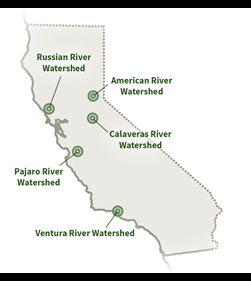
The Watershed Resilience Pilot Program was funded by the 2021 and 2022 Budget Acts, DWR launched the pilot program in 2024, awarding funds to five diverse regional planning projects. Each project focuses on local challenges. For example, the Regional Water Authority studies reduced snowpack effects on rivers, while Pajaro Valley Water Management Agency addresses sea level rise and saltwater intrusion. Several pilots are also partnering with Tribes for their expertise.
The pilot projects serve as the foundation for the Watershed Resilience Program.
2024 Watershed Resilience Pilot Program Funding Recipients:
- Pajaro Valley Water Management Agency
- Regional Water Authority
- Sonoma County Water Agency
- Stockton East Water District
- The Ventura County Resource Conservation
Solicitation Documents:
- Watershed Resilience Program - Pilot Overview
- 2024 Watershed Resilience Program Guidelines were released on January 25, 2024. The document provides general information and establishes the procedures that DWR used to implement the Watershed Resilience Pilot Program.
- Awards for the five pilots can be viewed here.
- California Watershed Resilience Assessment — This technical report presents the approach and findings of a statewide assessment of both climate risk and resilience preparedness at the watershed scale throughout California.
- Watershed Resilience Framework and Toolkit — The Watershed Resilience Framework serves as a roadmap for the State and regions to carry out climate resilience planning. The framework is paired with an online, interactive toolkit that offers planning guidance, best practices, case studies, resources and tools to conduct each step of the framework.
- Watershed Hub Resilience Indicators and Metrics — This technical memorandum describes the approach used to identify and recommend a preliminary set of water-related indicators and metrics to measure, track, and report on changing conditions throughout California’s watersheds.
- Addressing Complex Problems Together: A Network Study — A reflection on forming a network to implement integrated water management using Flood-MAR. This study provides an overview of how forming a network can address complex issues by identifying a shared purpose and bringing together organizations and individuals to work towards a shared outcome.
- Proposition 4 Workshop Presentation — An online presentation from April 30th, 2026, hosted by the Sustainable Groundwater Management Grant Program & Watershed Resilience Grant Program.
- Proposition 4 Workshop Slides — Presentation Slides from April 30th, 2026, Workshop.
Contact Us
For questions about the 2026 Guidelines or other issues, please contact DWR’s Financial Assistance Branch at (916) 651-9613 or by e-mail at FinancialAssistance@water.ca.gov.