
Lake Oroville Update - May 15, 2026
An aerial view shows high water conditions at Enterprise Bridge located at Lake Oroville in Butte County, California. Photo taken May 6, 2025.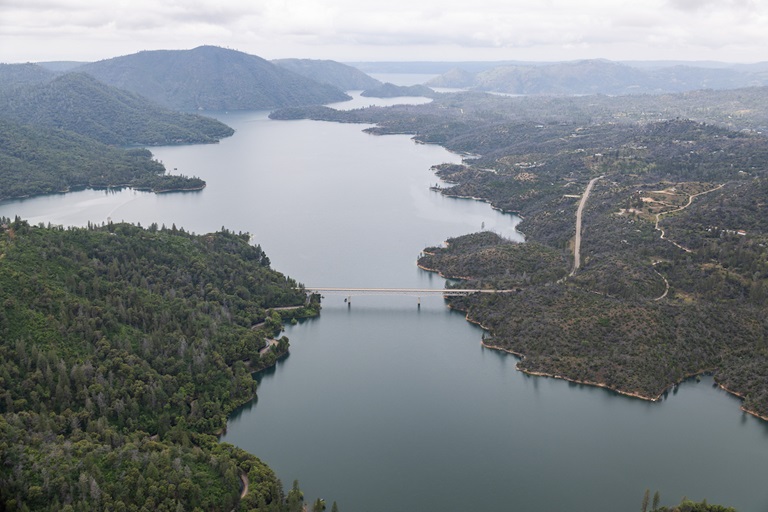
Lake Oroville Near Full Capacity
Lake Oroville is near full capacity thanks to average precipitation this fall and winter. The Department of Water Resources (DWR) is conserving as much water in the reservoir as possible, while still meeting water delivery and environmental requirements.
With the reservoir near capacity, windy periods are likely to cause water to splash onto and over the crest of the emergency spillway. This may cause minor surface wetting of the downstream side of the emergency spillway crest and the very upper sections of the concrete pad. Visitors to Oroville Dam may also notice minor amounts of water flowing from drains built into the emergency spillway. Both conditions are normal and expected in the emergency spillway design. The dam and emergency spillway continue to operate as intended.
Current reservoir levels are as follows, though estimates may change quickly:
- Current Oroville Reservoir Level: 897 feet elevation
- Current Storage: 99 percent of capacity
- Total Releases to the Feather River: 1,050 cubic feet per second
Lake Oroville is the largest storage facility in the State Water Project (SWP), providing flood protection while supporting environmental and water delivery needs for 27 million Californians. Some water released from Oroville for flood control is captured downstream for beneficial uses by local landowners, communities, and the State Water Project. Releases from Oroville Dam also support Feather River habitat for salmon, steelhead, sturgeon, and other river species. DWR continues to monitor lake levels, weather forecasts, and mountain snow levels to optimize water storage and allow for carryover storage into the following year.
Water Safety Month
SWP reservoirs located throughout California will welcome the upcoming summer months with robust water levels. When recreating at SWP facilities, visitors should always keep water safety a top priority and stay alert for cold, fast, and fluctuating water conditions.
During Water Safety Month, keep these water safety tips in mind to have a fun and safe summer:
- Wear a life jacket
- Swim in safe or designated areas only and near a lifeguard
- Swim with a buddy
- Be aware of drop-offs into deep water
- Watch for hidden debris and slippery rocks
- Look before you leap or dive
- Check for algal bloom updates
- Know your GPS location
Lake Oroville, the SWP’s largest reservoir, has more than 167 miles of shoreline and is a perfect location for boating, fishing, skiing, wakeboarding, swimming and paddleboarding. Those seeking to spend more than a day relaxing on the lake can stay at one of three campgrounds at the lake, or reserve floating campsites through the California Department of Parks and Recreation (State Parks).
Oroville Recreation
The Lake Oroville Visitor Center is open daily from 9 a.m. to 5 p.m. Staffed by knowledgeable guides, the Visitor Center features interpretive displays on Oroville Dam, area geology, wildlife and habitat, hydroelectric power, and cultural and historical artifacts. View videos in the theater about the construction of Oroville Dam, walk or hike along nearby trails, and visit the 47-foot-tall observation tower that provides unsurpassed panoramic views of surrounding areas. Free guided tours for school and community groups are available by reservation. Parking and admission to the Visitor Center are free.
Blue Green Algae Monitoring
DWR’s environmental scientists began monitoring for blue-green algae and their toxins last week within the Oroville-Thermalito Complex. Monitoring occurs during the summer with water samples taken at various locations regularly, which are sent to a lab for toxin analysis. There are currently no harmful algal bloom (HAB) advisories for Lake Oroville, the Thermalito Forebay, or the Thermalito Afterbay.
Blue-green algae (cyanobacteria) are a natural component of ecosystems. Under certain conditions, including warmer temperatures and increased nutrient loads, algae can grow rapidly causing “blooms.” Algal blooms sometimes produce toxins that can be harmful to people and animals. Algal blooms can make the water appear green, blue, or brown in color. Seeing colors, mats, foam, scum, or paint-like streaks in the water may indicate a bloom is present. Keep animals and children away from the water when a suspected bloom is present and report blooms immediately to the California Water Resources Control Board.
If testing reveals elevated levels of cyanobacteria toxins, DWR staff will work with California’s Regional Water Quality Control Board and recreation area managers to notify the public and post advisory signs at affected waterbodies. To learn more about HABs, or to report a HAB visit the Water Board’s website.
Feather River Fish Monitoring Station
DWR resumed operations of the Feather River fish monitoring station on March 4, 2026 to capture the return of spring-run Chinook salmon. Monitoring was temporarily suspended at the end of December 2025 due to anticipated high flows in the Feather River. Upstream migrating fish totals between March 4 and May 11, 2026 are:
- Spring-run Chinook salmon: 5,153
- Steelhead: -27 (most likely kelts moving downstream)
- To see previous year data, visit CalFish.org.
Current Lake Operations
Lake Oroville is at 897 feet elevation and storage is approximately 3.38 million acre-feet (MAF), which is 99 percent of its total capacity and 122 percent of the historical average.
Feather River flows are at 650 cubic feet per second (cfs) through the City of Oroville with releases from the Thermalito Afterbay River Outlet at 400 cfs for a total Feather River release of 1,050 cfs downstream. DWR continues to assess Feather River releases daily.
The public can track precipitation, snow, reservoir levels, and more at the California Data Exchange Center. The Lake Oroville gage station is identified as “ORO.”
All data as of 11:59 p.m. on 5/14/2026.
Know someone who would like to receive Community Updates? They can email their request to oroville@water.ca.gov.