
Four Years of Innovation and Teamwork: DWR Applies Science and Engineering to Support Winter-Run Chinook Salmon on the McCloud River
A drone photo of the California Department of Water Resources’ Juvenile Salmonid Collection System (JSCS) Pilot Project — in partnership with NOAA Fisheries, the California Department of Fish and Wildlife, the Winnemem Wintu Tribe and others — in the upper McCloud Arm of Lake Shasta in Shasta County, California. The study, in its fourth and final year, was designed to evaluate the feasibility and viability of collecting juvenile salmonids as they emigrate out of their historical habitat upstream from Shasta Dam. It’s the first step of a program to return endangered Chinook salmon to their historical habitats. Photo taken November 20, 2025.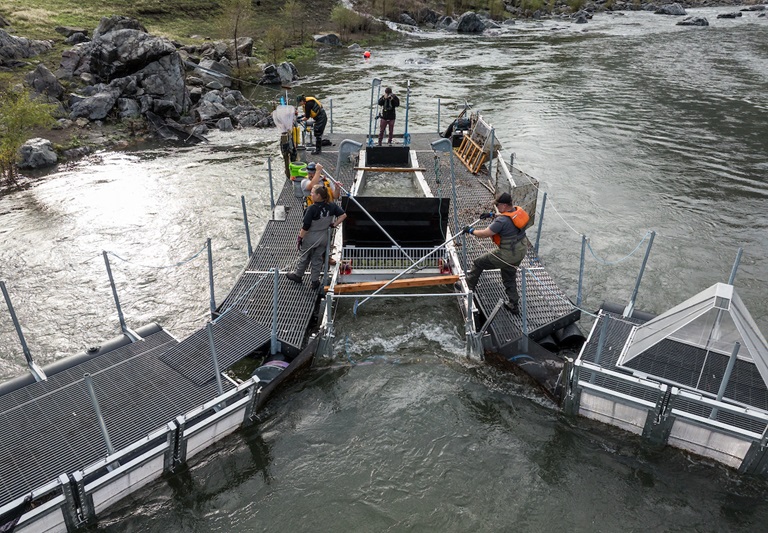
On the waters of Northern California, just off of Shasta Reservoir, a bold four-year pilot study is wrapping up that could help change the future for one of the state’s most endangered species: winter-run Chinook salmon. Led by the California Department of Water Resources (DWR), with support from state, federal, and Tribal partners, this effort aims to give this species a fighting chance to complete their life cycle and reconnect to the habitat they need to survive.
Shasta Reservoir serves as an important piece of water infrastructure, providing essential water supply and flood control for the region. However, the construction of Shasta and Keswick dams blocked access to historical high-elevation, cold-water habitats that are vital for native fish populations, such as winter-run Chinook salmon. Today, these populations face significant challenges, emphasizing the need for continued investment in cold-water solutions so that the species can survive in the Sacramento River watershed as the climate warms.
Recognizing the need for action, a coalition of agencies and partners launched an ambitious four-year pilot study to reconnect these fish with the cold-water habitat they need while also devising a way for the fish to continue their migration to the ocean after hatching. The study aims to safely capture juvenile winter-run Chinook salmon before they enter Shasta Reservoir, carefully place them in transportation containers, and then drive those containers downstream, bypassing the dams.
The centerpiece of this effort for DWR is the Juvenile Salmon Collection System (JSCS), which was engineered, built, and operated by DWR to capture juvenile salmon before they enter Shasta Reservoir. Made possible through funding from the California Department of Fish and Wildlife (CDFW), DWR’s team began the study in 2022 with the first version of the JSCS.
Since that first year, data was collected and used to create an improved, second version of the JSCS in late 2025. That same year, the JSCS was also relocated directly into the river environment instead of its previous location where the river meets the reservoir. This change led to improved results such as reducing predator presence and increasing collection numbers.
To verify the success of the JSCS, DWR conducted “efficiency releases,” which is when staff release hatchery-raised juvenile salmon upstream of the JSCS and then see how many of those fish are collected in the trap.
The ultimate measure of this project’s success isn’t just the fish that are caught in the JSCS, but the adults that return in the future. These fish must travel hundreds of miles to the ocean, mature, and migrate their way back to these waters.
This study has seen success, with documented returns of adult winter-run Chinook completing their incredible lifecycle. DWR has confirmation that at least two pairs of adults made it back from the lake to spawn in the McCloud River. DWR hopes in the future there will be returns from the ocean that validate the immense effort poured into this program and prove that reintroduction is a viable pathway for the species.
This achievement is not the work of a single agency. It is the result of a deep collaboration between DWR, CDFW, the Winnemem Wintu Tribe, NOAA Fisheries, the U.S. Fish and Wildlife Service, and in partnership with the U.S. Forest Service, an agency of the U.S. Department of Agriculture.
As this pilot study concludes, DWR looks forward to applying these lessons to future fish passage solutions.
To see the progress of the JSCS, videos from the first year, second year, and final year of the project are available as well as photos on DWR’s Pixel gallery.