
Lake Oroville Update - April 29, 2026
A drone view of the Canyon Creek bridge at Lake Oroville in Butte County, California. Photo taken April 4, 2025.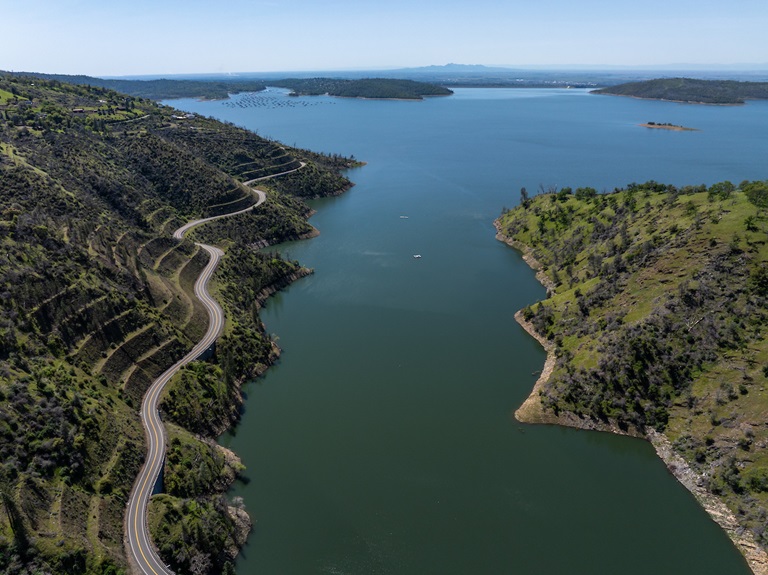
DWR Modifies its Invasive Mussel Inspection Program at Oroville
The California Department of Water Resources (DWR) is modifying its inspection program for invasive mussels at Lake Oroville, the Thermalito Forebay, and the Thermalito Afterbay. Effective today, April 29, watercraft inspections, decontamination services, and seal checking at the Oroville facilities are no longer required. Blue Oroville seals are no longer required to launch watercraft and owners have permission to remove seals themselves, as inspectors will no longer be stationed at launch ramps. DWR will also reopen facilities that were closed to trailered launching including those at the Thermalito Forebay and Thermalito Afterbay. At locations requiring the removal of physical barriers, additional time will be required for crews to fully reopen facilities. Launching access at Lake Oroville will once again be available 24 hours a day, every day.
The decision to implement an invasive mussel boat inspection program at DWR’s Oroville facilities in May 2025 was based on available information about how best to protect DWR infrastructure from golden mussel establishment. While DWR does not control many of the lakes and reservoirs upstream of Lake Oroville, it quickly established a program to reduce the potential risk of invasive mussel introduction through recreational boating. Additional analyses of golden mussel biology and habitat requirements, as well as an assessment of DWR’s Oroville infrastructure, have shown a lower risk of golden mussel establishment than was originally anticipated.
During the last year, DWR performed a vulnerability review of Lake Oroville, the Upper Feather River Lakes, the Feather River Fish Hatchery, and Oroville-Thermalito Complex infrastructure to golden mussel colonization. The seasonal water temperature conditions at Lake Oroville and the Upper Feather River Lakes were evaluated based on a 2017 study in which researchers assessed the conditions golden mussels need to survive and reproduce.
For golden mussel maturation and reproduction to occur, water temperatures greater than 61.7°F for about 150 days are necessary for successful spawning and the formation of veligers, the larval stage of mussels. For veligers to complete their development and settle into a hard-shell mussel, water temperatures must be nearly 70°F for approximately 70 days.
Temperature thresholds for golden mussel maturation exist within the top 60 feet of Lake Oroville, meaning that sustained mussel populations would be confined to specific areas of the reservoir, such as floating infrastructure, and boats that remain on the water for lengthy periods. Mussels could survive in shallow shoreline locations until lake levels drop, at which point they would dry out and die. Extended cold water temperatures in the Upper Feather River lakes, the depth of Lake Oroville, and the continuous cold water releases from Oroville Dam to support salmon habitat are limiting factors for golden mussel spawning and larval development. Any veligers that are transported through the dam at lower lake elevation temperatures would be unlikely to survive, would have a difficult time growing, and would not have a significant impact on the Feather River Fish Hatchery and Oroville-Thermalito Complex powerplants.
Given this analysis of potential impacts to State Water Project infrastructure, DWR is no longer requiring watercraft inspections at Oroville. Ongoing water testing and visual inspections of infrastructure for invasive mussels will continue. Golden mussels have not been detected at DWR’s Oroville facilities or the Upper Feather River lakes. Program changes are being coordinated with local recreation partners at the California Department of Parks and Recreation and the California Department of Fish and Wildlife.
DWR continues to partner with federal, State, and local agencies to mitigate golden mussel colonization throughout California’s water systems. This includes coordinating with partners on a statewide reporting system for watercraft, continued public education campaigns about golden mussels and how they spread, ongoing studies about effective treatment options, and implementing a variety of mitigation and maintenance actions to maintain State Water Project operations that are currently affected by the presence of golden mussels.
When recreating on California’s waterways, always remember to:
- Clean aquatic plants and animal material from your boat, trailer, and equipment before leaving the ramp or parking lot.
- Drain ballast, bilge, live-wells, and other water-containing devices, and never drain back into the waterway.
- Dry equipment, including bilge, ballast tanks, and live well, before launching into another body of water.
More details about DWR’s invasive mussel inspection program are available at water.ca.gov/mussels.