
Lake Oroville Update - December 19, 2025
A new spherical valve is transported on a barge in front of Oroville Dam’s main spillway. 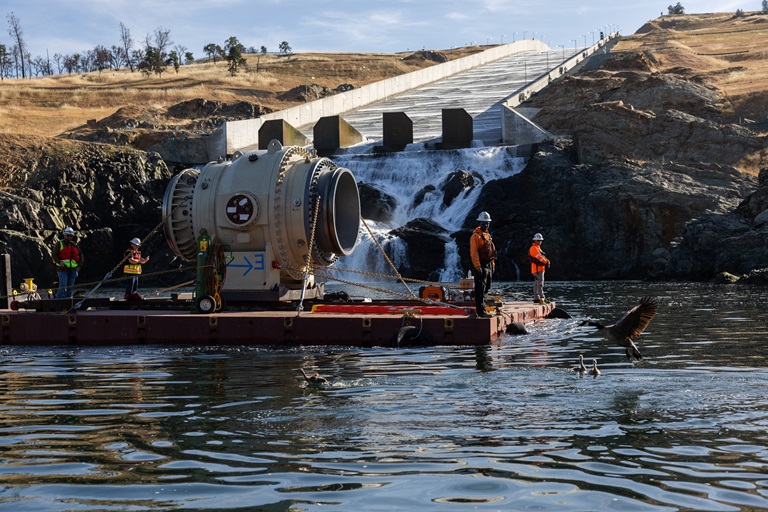
A Year in Review
While the start of 2025 saw steady increases to Lake Oroville’s water storage levels, strong atmospheric rivers in late January and early February delivered significant precipitation to Northern California. In advance of forecasted storms, the Department of Water Resources (DWR) began required flood control releases from Lake Oroville for the third year in a row, providing critical flood protection to downstream communities. DWR maintains storage space in Lake Oroville during the typical wet weather months to ensure adequate space remains in the reservoir to capture runoff from rain and from spring snowmelt. Releases are coordinated closely with the U.S. Army Corps of Engineers and other water operators and adjusted as needed.
While portions of Southern and Central California remained abnormally dry throughout the winter and spring months, the Feather River watershed received enough precipitation and snowpack runoff to fill Lake Oroville to capacity by early June for the third year in a row, marking a record since the dam’s construction. As the largest storage facility in the State Water Project, Lake Oroville helps provide water to 27 million Californians and 750,000 acres of farmland, making spring an important time for water project operators to fill reservoirs ahead of dry months.
In the largest Forecast-Informed Reservoir Operations (FIRO) assessment to date, DWR and Yuba Water Agency (Yuba Water) partnered with the Center for Western Weather and Water Extremes (CW3E) at UC San Diego’s Scripps Institution of Oceanography and the U.S. Army Corps of Engineers’ (USACE) Engineering Research and Development Center to evaluate if FIRO could be implemented at both Oroville and New Bullards Bar reservoirs to reduce downstream flood risk without negatively impacting water supplies. FIRO, uses improved monitoring, weather, and runoff projections to build more flexibility and efficiency into reservoir operations. Using historical forecasts, reservoir storage and river flow data, scientists found that FIRO, along with a planned second spillway at New Bullards Bar, could provide additional flood storage capacity in the Yuba-Feather system and reduce downstream peak flows during prolonged storms like the 1986 and 1997 floods that devastated Yuba County.
In early May, DWR announced the start of an invasive mussel inspection program for watercraft at its Oroville facilities to prevent the introduction of golden mussels. Golden mussels range from ½ inch to 2 inches in size and have a light to dark yellowish-brown to brown-colored shell. When golden mussel populations are established, they are difficult to control since they can become very abundant and are easily spread to new waterbodies by watercraft. Before launching, watercraft must be inspected, certified as mussel-free, and obtain a designated blue Oroville seal. Inspection and decontamination services for the Oroville facilities remain free.
In June DWR began construction on a project to replace power and fiber optic communication lines that support the Hyatt Powerplant and Thermalito Diversion Dam Facilities. Extended closures of the Brad Freeman Bike Trail and the Dan Beebe Trail between the Thermalito Diversion Dam and Powerhouse Road, including Lakeland Blvd., will continue through summer 2026 for ongoing construction activities.
The California Department of Parks and Recreation (State Parks) reopened the Craig Saddle Boat-in Campground at the Lake Oroville State Recreation Area (LOSRA) in July. Five years ago, the deadly North Complex Fire burned more than 318,000 acres in Plumas and Butte Counties. Multiple communities sustained catastrophic damage, and the landscape across much of the east side of Lake Oroville, including the Craig Recreation Area of LOSRA, experienced high-severity wildfire. State Parks rehabilitated the landscape adjacent to Craig Access Road within the LOSRA boundaries and restored the boat-in campground area through removal of dead, burned trees and vegetation. Approximately 7.7 acres of the boat-in campground will continue to be treated for long-term restoration to re-establish native trees, shrubs, and grasses to enhance habitat and improve watershed function.
In August, DWR started a paving and sealing project to rehabilitate several locations owned and maintained by the department that are heavily used by maintenance staff and public members. While work was completed at several locations, construction work was suspended for the winter. Future work locations include sections of the Thermalito Afterbay Dam Crest Road, the Feather River Fish Hatchery, and the Oroville Field Division Operations and Maintenance Center. Work is expected to resume in May 2026.
DWR completed routine annual cleaning and inspections of Oroville Dam’s main spillway chute to assess the condition of the spillway’s concrete slabs, walls, joint sealant, and dentates (energy dissipators at the base of the spillway structure). Following inspections, minor concrete repairs and joint sealant work were identified and completed in localized areas of the spillway. While the main spillway continues to perform well and operate as designed, periodic concrete and sealant repairs of the spillway are expected due to seasonal temperature variations, spillway releases, and sun exposure. In addition, minor maintenance work on the emergency spillway over a one- to two-week period is expected to begin at the end of December. The schedule is subject to change due to weather.
Construction work also continued on the River Valve Outlet System (RVOS) at Oroville Dam. The system is a series of two parallel outlet conduits, each with two valves, that have the capacity to draw water from deep in Lake Oroville for release. The RVOS is a critical feature of the dam, providing the ability to discharge cold water to the Feather River to maintain water temperatures necessary for fish health. It also ensures the ability to maintain Feather River flows through RVOS releases during drought years, especially if reservoir levels drop below Hyatt Powerplant’s water intake structures.
The Feather River fish monitoring station continued to provide valuable data for counting Chinook salmon and steelhead populations. Accurate estimates allow DWR and its partners, like the California Department of Fish and Wildlife and National Marine Fisheries Service, to track the success of hatchery activities along with environmental and fishing impacts. Approximately 17,700 spring-run were estimated in the Feather River in 2025, the best return since 2013. Chinook salmon that migrate up the river starting in July are considered fall-run, with the monitoring station tracking more than 43,400 fall-run between July 1 and Dec. 16, 2025.
Vegetation management and fire mitigation work occurred throughout the year on DWR property along Oro Dam Blvd. East near the Hyatt Powerplant, the Bidwell Canyon/Kelly Ridge area, and the Loafer Creek State Recreation Area. DWR's Fuel Load Management Plan is reducing hazardous fuels and the risk of catastrophic wildfire by thinning vegetation using hand and mechanical methods, accompanied by chipping, pile burning, and prescribed fire. By proactively reducing ground fuels, thinning overgrown vegetation, and removing dead and dying vegetation, firefighters have a better chance at suppressing a potential wildfire. From early 2013 through June 2024, DWR and its local partners have treated or retreated more than 2,600 acres of vegetation.
DWR’s Floating Classroom program also returned this fall, offering free educational rafting tours on the Feather River to local schools and public members. The Floating Classroom program takes participants through Feather River spawning habitat while scientists with DWR and Pacific States Marine Fisheries Commission provide information on Chinook salmon conservation efforts, ongoing and planned research, restoration and monitoring projects, and fisheries management activities supported by DWR’s State Water Project (SWP). This year’s program provided free education to more than 1,000 local students, parents, and teachers, and approximately 480 community members.
Annual Chinook salmon and steelhead spawning activities at the Feather River Fish Hatchery in Oroville were also completed. The Hatchery collected enough Chinook salmon eggs to meet its production goal of 3 million spring-run fingerlings and 6 million fall-run fingerlings, with additional eggs collected to increase production this year. In addition, the Hatchery raised approximately 508,700 yearling steelhead trout around 8.5 to 9.5 inches in length for 2025 releases. The Feather River Fish Hatchery is a SWP facility built in the late 1960s by DWR to mitigate impacts on fish migration resulting from the construction of Oroville Dam. DWR owns and maintains the facility and provides funding to the California Department of Fish and Wildlife (CDFW) to perform spawning, rearing, and stocking operations.
DWR looks forward to initiating and completing more projects in 2026 at the Oroville-Thermalito Complex. The Lake Oroville Community Update will continue to share news and information with the community.
Golden Mussel Inspection Program
DWR is reminding the public that boat ramps at Lake Oroville are no longer open 24/7. Watercraft must be out of the water by ramp closing time or they will be locked into the facility overnight. Please plan ahead. More details about DWR’s mussel inspection program are available at water.ca.gov/mussels.
Watercraft Inspection Location/Decontamination Services
North Thermalito Forebay at Garden Drive and HWY 70 in Oroville
Hours of operation: Daily from 8:30 a.m. to 4:30 p.m.
Sealed Vessel Launching (Including Holidays)
Lake Oroville
Ramp hours: Daily from 7:30 a.m. to 6:30 p.m.
- Spillway
Ramp hours: Monday-Thursday 7:30 a.m. to 6:30 p.m.; Friday-Sunday 7:30 a.m. to 8 p.m.
- Bidwell Canyon
Ramp hours: Monday-Thursday 5 a.m. to 6:30 p.m.; Friday-Sunday 5 a.m. to 8 p.m.
- Lime Saddle
Ramp hours: Daily from 5 a.m. to 6:30 p.m.
- Loafer Creek/Loafer Point
Thermalito Afterbay
Ramp hours: Daily from 1.5 hours before sunrise to 1 hour after sunset
- Monument Hill
Thermalito Forebay
Ramp Hours: Daily from 8 a.m. to sunset
- North Forebay (Non-motorized vessels only)
Oroville Recreation
DWR is closing the Lakeside Access Road at Lake Oroville in anticipation of rising reservoir levels. Starting Monday, Dec. 22, vehicle access to the Spillway Boat Ramp and Day Use Area will be via Oroville Dam Crest Road through the CHP screening. The Spillway Boat Ramp and Day Use Area is open daily from 7:30 a.m. to 6:30 p.m.
Stop by the Lake Oroville Visitor Center for free winter-themed craft activities for kids ages three and older! Located at 917 Kelly Ridge Road in Oroville, the Visitor Center is open daily from 9 a.m. to 5 p.m. Snow-cember weekend craft activities are offered between 10 a.m. and 4 p.m. and include:
- Dec. 20-21: Pipe cleaner snowflake ornament and take-home salt crystal snowflake experiment
- Dec. 27-28: Paper plate swirly snowman and snowman wreath
- Jan. 3-4: Pasta snowflake art and icicle ornament
The Lake Oroville Visitor Center will close all day for the Christmas and New Year holidays. Visitors may still access nearby trails during the holiday closures.
Between Jan. 30 and April 20, high flows in the Feather River required the temporary removal of fish monitoring equipment resulting in lower spring-run estimates. Upstream migrating fish totals through the Feather River Fish Monitoring Station between Jan. 1 and Dec. 16, 2025 are:
- Spring-run Chinook salmon (April 16 through June 30): 17,712
- Fall-run Chinook salmon (July 1 through present): 43,461
- Steelhead: 1,742
- To see previous year data, visit CalFish.org.
Current Lake Operations
Lake Oroville is at 766 feet elevation and storage is approximately 1.75 million acre-feet (MAF), which is 51 percent of its total capacity and 97 percent of the historical average.
Feather River flows are at 650 cubic feet per second (cfs) through the City of Oroville with 1,100 cfs being released from the Thermalito Afterbay River Outlet (Outlet) for a total Feather River release of 1,750 cfs downstream. DWR continues to assess Feather River releases daily.
The public can track precipitation, snow, reservoir levels, and more at the California Data Exchange Center. The Lake Oroville gage station is identified as “ORO.”
All data as of midnight 12/18/2025.
DWR wishes everyone a happy holiday season.
The Lake Oroville Community Update will return on January 9, 2026.