
Cloudy Water, Clear Decision: Using Science to Protect Fish and Water Supply
A drone view at dusk shows Clifton Court Forebay, which is managed by the California Department of Water Resources, at the southwestern edge of the Sacramento-San Joaquin Delta in Contra Costa County. Photo taken March 3, 2025.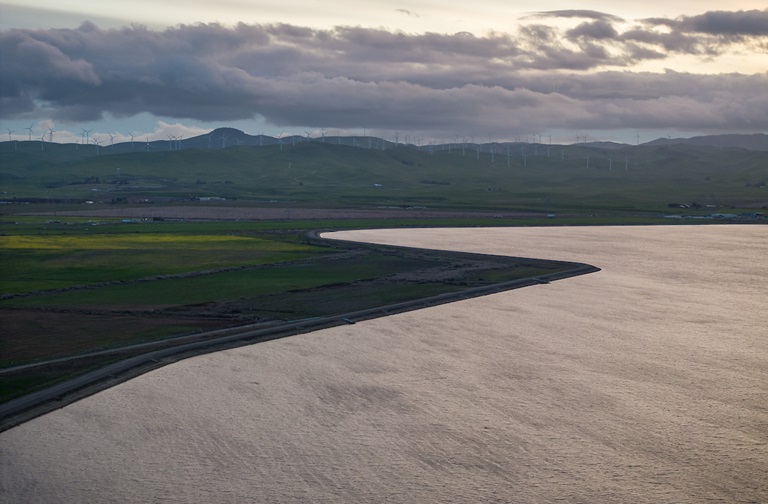
When the first major storms of the season arrive in California, they bring more than just water. Those early storms trigger what is known as “first flush,” a short but important period that plays a big role in the ecology of the Sacramento-San Joaquin Delta, how the State Water Project (SWP) operates, and the actions taken to protect fish in the Delta.
When the season’s first significant storms arrive, high river inflows mobilize sediments from the river bottom resulting in a large surge of cloudy, or turbid, water from upstream areas to the Delta.
This initial influx of turbid water is typically different than storm runoff that happens later in the season because it often injects more sediment into the Delta and marks the end to California’s dry season in a way that several native species use to cue seasonal migrations. The importance of first flush for the ecology of the Delta is also why first flush is important for SWP operations, as they must balance water delivery with environmental protection.
Since river conditions can change as quickly as the weather does, the SWP uses real-time data to guide operational decisions. Earlier this month, the Department of Water Resources (DWR) received approval from the California Department of Fish and Wildlife (CDFW) for an amendment to the Incidental Take Permit (ITP) that helps guide operations of the SWP. The amendment allows for flexibility in decision-making around fish protection actions. Analysis done by DWR scientists shows that the rules governing SWP operations during these actions can sometimes be relaxed without impacts to listed species.
The turbid water that moves into the Delta during first flush can make it difficult for fish to see, which protects native fish from predation and allows them to move more freely in the Delta. As they move, fish could be more susceptible to SWP pumping that can alter Delta water movements, leading fish to end up at the SWP fish salvage facility in the south Delta. To protect endangered fish, SWP water managers may reduce water exports during this critical period. Continued monitoring of Delta conditions by DWR scientists, along with flexibility from the new ITP amendment, means SWP water managers can adjust pumping as needed. Last week, the SWP was able to pump an additional 6,000 acre-feet of water per day during first flush conditions brought on by recent storms, benefiting the water supply but also balancing protections for endangered fish species. New modeling and analyses conducted by DWR indicated that there were only minor differences in impacts to endangered species at flow requirements less than –5,000 cfs compared to more substantial impacts at flows greater than –5,000 cfs.
First flush is a critical period for both endangered species and California’s water supply, but with advanced monitoring tools, real-time data, and close coordination with partners, the SWP is equipped to respond quickly to protect both endangered fish and the water supply for 27 million Californians.