Program Mandate and Scope

Sustainable forest ecosystem management involves holistic, interdisciplinary engagement across working forests, interspersed communities, and protected areas. The Timber Regulation and Forest Restoration Fund (Fund), established in 2012 under Assembly Bill 1492 (Chapter 289, Statutes of 2012; AB 1492), places a one percent assessment on lumber and engineered wood products sold at retailto pay for state agency staffing, permitting, oversight, and environmental protection of California’s forested ecosystems (Figure 1). The Fund supports approximately 206 agency staff at the California Natural Resources Agency (CNRA), the Board of Forestry and Fire Protection (Board), the California Department of Forestry and Fire Protection (CAL FIRE), the Department of Fish and Wildlife (CDFW), the Department of Conservation’s California Geological Survey (CGS); and the California Environmental Protection Agency’s State and Regional Water Quality Control Boards (Water Boards).
The Timber Regulation and Forest Restoration Program (Program) established by AB 1492 has an annual operating budget that varies year by year but ranges from approximately $69 million - $111 million. These funds enable interagency staff to work closely to build and maintain interagency cohesion, efficiency, and performance in the management of California’s forested ecosystems. Extensive collaboration occurs outside the Program’s main departments, including work with other state and federal agencies and partner organizations. While engagement on private lands and State Responsibility Areas (SRAs) is central to the Program focus, the Program scope and mandate also address public lands including those managed by the US Forest Service and Bureau of Land Management (i.e., all forest types and ownerships). CNRA leads the implementation of the Fund and the Program in collaboration with the California Environmental Protection Agency (CalEPA).
A major component of the Program is to provide efficient and consistent environmental oversight of commercial timber harvest on California’s non-federal timberland to protect natural resources while allowing sustainable harvest. Commercial timber operations on non-federal forestlands in California are regulated under the Z’berg-Nejedly Forest Practice Act (Act) and implemented under the California Forest Practice Rules (Rules). The Act establishes the goal of ensuring a thriving and sustainable timber industry that supports California’s ecological objectives, protection of soil, water quality, and conservation of wildlife habitat.
Interagency Program staff are actively engaged in core duties to conduct timber harvest review; fulfill policy and oversight functions including new regulation development and enforcement; ensure transparency and efficiencies through monitoring and online permit innovations; and support forest and watercourse restoration. Related to these legislatively mandated duties, may of the highlighted duties listed below have emerged since the creation of the Program and absorb significant staff time. These include, but are not limited to:
- Emergency wildfire prevention work including expediting of critical fuels reduction projects.
- Emergency response to post-wildfire watershed hazard identification and community recovery associated with flood and winter storm events.
- Oversight of Emergency Notice filings (permits to allow immediate salvage of timber after a loss due to fire, insect or other agent).
- Oversight of Exemption filings (pre-mitigated, non-discretionary timber harvest permits that allow for operations to commence faster than a normal THP).
- Implementation of the new California Vegetation Treatment Program (CalVTP) to streamline environmental review of non-commercial vegetation management for wildfire resilience projects.
- Reviewing and approving grant allocations associated with wildfire resilience and forest health initiatives.
- Execution of Governor’s Wildfire and Forest Resilience Task Force (Task Force) Action Plan
- Review of annual utility Wildfire Mitigation Plans in coordination with the Office of Energy Infrastructure Safety.
- Response to pending species listings.
- Response to issues with illegal timberland conversion and other violation types.
- Support and oversight of State-owned land vegetation management implementation.
Some of the above-listed actions are episodic, aligned with disaster declarations, while others are long-term work areas Program staff are continually addressing.
Annual Reports to the Legislature
To read more about the Timber Regulation and Forest Restoration Program’s focus, budget, staffing, program activities, and performance, Annual Reports to the Legislature are provided below.
- Fiscal Years 2016-17, 2017-18, 2018-19
- Fiscal Year 2019-20
- Fiscal Year 2020-21
- Fiscal Years 2021-22 and 2022-23
- Fiscal Year 2023-24
- Fiscal year 2024-25
Timber Harvest Permit Process | Evaluating Effectiveness and Identifying Efficiencies
Independent, Third-Party Evaluation of California’s Timber Harvest Plan Review Process Now Available
An independent evaluation of the Timber Regulation and Forest Restoration program’s performance and processes for conducting California Timber Harvest Plan (THP) reviews has been completed and is now available. California Timber Harvest Plan Workflows and Process | Independent Evaluation of Program Performance
The evaluation, conducted by Sacramento-based consultant NiVACK Group under contract with the California Natural Resources Agency (CNRA), looked at the effectiveness and efficiency of the THP process and workflow. The objective was to identify opportunities for process or policy improvements to THP review from plan submittal, through interagency review, to final notice of approval.
NiVACK’s report found that while the THP process functions as designed, there are opportunities to improve transparency and bring clarity to the process and workflow. The report offers recommendations intended to yield a more effective, efficient and technologically improved experience for parties involved in the process, including small landowners, industrial timber operators, California Native American tribes, the public and review team personnel.
Upcoming
June, Forest Practice Committee, Board of Forestry and Fire Protection | Follow-up Discussion:
On June 16th, the Timber Regulation and Forest Restoration Program Leadership Team will discuss consolidated recommendations derived from the Lean Six Sigma analysis and program priority work areas that are responsive to the report findings and informed by public feedback. These recommendations reflect additional public comment received at the workshop on May 15th 2026.
NOTE: In-person or online attendance is possible- refer to Board of Forestry website for more details on the June meeting
Past Meetings
March 2026 Board of Forestry Presentation:
NiVACK presented an overview of the report and its recommendations at the March 11, 2026 meeting of the Board of Forestry and Fire Protection (see meeting recording before the full Board).
May 2026 Roundtable Discussion (In-Person or Online):
CNRA and the California Environmental Protection Agency (CalEPA) hosted a roundtable discussion to solicit feedback from interested parties regarding recommendations made in the report.
Review PowerPoint Presentation
Background
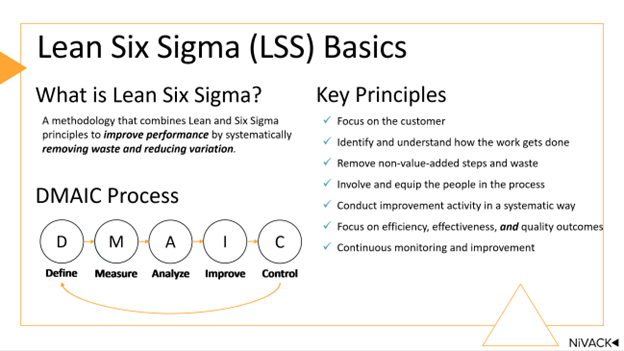
In summer 2024, after more than a decade of program operations, CNRA contracted with the NiVACK Group to complete an independent Lean Six Sigma (LSS) analysis to evaluate the effectiveness and efficiency of California’s THP process and workflows that are carried out in fulfillment of the State’s environmental compliance standards associated with delivering timber harvest permits. NiVACK conducted its analysis, consulting data provided by state agencies, and through a series of one-on-one interviews, online surveys and stakeholder listening sessions involving agency personnel and industry, small landowners, non-government organizations, environmental justice groups, and tribal representatives.
For questions, contact Loretta Moreno, Environmental Program Manager at Loretta.Moreno@resources.ca.gov.